Showing posts with label Content. Show all posts

Four Interesting Trends from Dreamforce

Last week I had the pleasure of wandering the floor at Dreamforce, Salesforce.com’s annual conference. As the SaaS conference of the year, it’s a great time to get a pulse on how everyone is thinking about the next few years. This year, I spent a lot of time talking with the exhibiting ISVs, both large and small, and as I did so, I found a few key themes that resonated.

At Eloqua, we’ve been talking about Revenue Performance Management for a while now, and it was good to see that many of the themes that are driving that are common across other ISVs in the ecosystem. Here are four themes I noticed as I chatted with vendors on the show floor:

1) Data is Increasingly Critical: One clear trend was the increasing importance of data to those focused on driving revenue. Both as a source of new conversations, and as a source of continually updated insight into a buyer’s fit, data is one of the most important RPM stories of the next few years. Salesforce.com has clearly made a significant investment in this area with their acquisition of (and deep integration of) Jigsaw as a data cloud, but folks like Hoovers, D&B, and StrikeIron were very present on the show floor with data sourcing, append, and cleansing services.

2) Communication Contributes to Buyer Insight: There were many vendors who provided communication tools, ranging from PDF trackers to videoconferencing tools and Webinar providers. This was not new, but in each conversation with these providers, including Vitrium, ReadyTalk, iLinc, and more, their focus was on how the use of that communication tool by a buyer can provide rich insight into a buyers intentions. By leveraging attendance data as a key part of a buyer’s digital body language, marketers and sales people are much better armed.

3) Integration Must Be Seamless: Salesforce.com has long focused on the need to seamlessly tie together all interactions with customers, and this viewpoint is spreading throughout the entire buying process. Integration providers like Cast Iron, Informatica, and Pervasive had packed booths as visitors looked to understand how to seamlessly tie together every pre-purchase interaction, whether in social media, search, webinars or in any other communication vehicle.

4) 2011 will be the Year of Analytics: It is now beginning to be possible to see the entire buying process from end to end. With that possibility, revenue analytics jumps to the forefront as an extremely hot area. Both on the floor and in the track sessions, executives were asking about the right metrics, measurements, and KPIs to measure in order to ensure that their revenue engines were running in the most efficient manner possible

I have never been more excited about the RPM space, and seeing the breadth of solutions on display at Dreamforce tells me that others quite definitely share this excitement. 2011 will be an exciting year indeed.

Read More...

Cartoon: Who is creating content for your company?

Today's my first attempt at cartooning (okay, not really, all the hard work was done by gifted cartoonist Brady Bonus). I hope you enjoy it!

First posted this morning on It's All About Revenue:
Read More...

Marketing Dashboard: Passive Discovery

We spoke recently about various ways of looking at marketing benchmarks and how to better dashboard and analyze the entire revenue performance management process. This thinking needs to be applied to all areas of the revenue engine, and each has its own unique challenges.

At the earliest stages of the funnel, where buyers first begin to become aware of your company and its solutions is perhaps the most challenging. One of the main ways in which people discover your message, of course, is coming across your messages "passively", through ads, content, and social media sharing.

Building an understanding of how your messages are being passively discovered is an interesting challenge. Many of the paid techniques of passive discovery, such as banner advertising, are inherently trackable. However, great content that allows an organization to earn passive discovery is often much less trackable. However, a clear understanding of this element of the revenue process is key to determining where to make important investments.

An important metric to start with is an understanding of paid vs earned awareness. This dashboard metric gives you a clear sense of whether prospective buyers in the early stages of their education process are learning about you through paid efforts, such as advertisements, or through your efforts to earn their attention, such as through content marketing. To create this view, chart the traffic to your website by its originating source. Those that arrive from content sites, or without the tracking codes that you place in your online advertisements are most likely earned discovery through your content marketing efforts. Those that arrive with the tracking codes of your online advertising efforts are paid discovery efforts bearing fruit.

In charting these two sources of awareness, all active discovery, such as referrals from search sites such as Google and Bing, and all natural traffic (visitors who just typed in your website’s address, and were not referred to it), must first be removed. Other sources of traffic, such as from a customer community, or online help portal should also be excluded, as these are individuals who are already aware of who you are and what your solutions are. With these categories of traffic removed, this leaves just the visitors who discover your content, and hence become aware of your solutions, through either paid or earned awareness efforts.

This view is instructive in two ways. First, a direct comparison of your paid and earned efforts provides insights into whether opportunities might exist that are not being maximally exploited. If you notice that prospects discovery of your solutions is mainly from paid sources, there is an opportunity to assess whether content marketing efforts may provide a more economically efficient way to drive awareness. If, however, all of your discovery traffic is coming from earned sources, there may be a chance to either re-evaluate whether your current paid awareness efforts could be better targeted, or, if there is an opportunity to increase your paid awareness efforts in order to generate awareness in areas of the market in which you are not currently driving as much awareness as you could be.

The second area of value you get from creating and maintaining this view of your revenue engine is that you can understand how your efforts are resulting in more awareness over time. This is most crucial for earned media, as this follows a “fly-wheel” dynamic for growth. Effort this is invested in creating and promoting great content results in a slow and steady growth in awareness. This dynamic is much different than the “lightning strike” dynamic of most paid media efforts where an investment results in a near real-time effect.

Calculations of the total audience to which your messages are presented in a way that allows them to be passively discovered is similarly simple for paid audiences, but challenging for earned audiences. For paid audiences, the total coverage of your advertisements (number of “eyeballs”) forms a good audience proxy. However, to calculate the total audience for earned awareness (mostly in the form of content sites that mention your company or solutions), it may be simpler to do this by assuming a known conversion rate and using that to calculate what the overall audience must be, based on traffic.

While this technique obviously prevents any insights that might have been gained by understanding and analyzing traffic conversion rates, in earned passive awareness, this is often not something that can be easily optimized as there is very limited control over how and where you are mentioned, so the best action is often simply to drive audience sizes higher through garnering more share of the conversation.

Analyzing Paid Discovery – Advertising and Audience Definitions

In building a dashboard to show the effectiveness of advertising efforts, the focus is on understanding how to target audiences that will effectively convert into interested buyers. This area of the industry is evolving rapidly, and an important development is in how audiences are defined. Historically, an audience was defined mainly by the content itself, with a thin layer of demographics on top.

For example, an industry new site focused on printing technologies in the publishing sector could be assumed to have an audience of people involved in that discipline. Within this audience, advertisers could often target by title or organization fit based on declared demographics, but not much more.

In today’s online world, this is rapidly changing. The major content networks are beginning to provide the ability to target audiences based on historical activity. For example, those who visit certain pages on your site, or meet certain qualification criteria could be defined as a specific audience, regardless of where they are on the Internet, for having specific ads presented to them.

In analyzing advertising campaigns, this analysis of audience becomes critical. While remarketing audiences are likely to have substantially smaller sizes than their mainstream counterparts, they may offer opportunities to convert prospective buyers to MQLs at a much higher rate or present more precise information that is relevant to later stage investigation and validation only.


Inbound Links – Earning the Potential to be Discovered

Traffic to your web properties is the most tangible metric to dashboard when looking at passive discovery. However, when it comes to the efforts to earn this discovery, it is a difficult metric to use in order to guide decisions as it is an aggregate measure of all the content that is linked to. Efforts to build great content and share it with influencers lead to a more measurable metric of inbound links.

An inbound link is a link from another site on the web to a page of content on your website. Creating interesting, useful, and valuable content leads to more links, and each link increases the chances that your content will be discovered by those reading about the market space. Obviously, links from higher traffic and more credible sites increase this potential more than links from less relevant sites.

To gain an understanding of the success of your content marketing strategy, and areas for improvement, a dashboard of inbound links can be very useful. For each major area of your web properties, such as your main site, blogs, and campaign-specific sites, dashboard the total number of inbound links, the average quality for each inbound link (based on the traffic and credibility of the page the link resides on), and the number of visits generated by that link in the recent time period.


This dashboard view provides insights into the successes and challenges of efforts to create exceptional content that inspires others to link to it. If top level analysis of passive discovery shows levels of performance that are less than expected, an inbound link analysis can identify where the issues might be occurring.

Social Engagement and Passive Discovery

As social networks grow in importance as a medium through which information is shared, so too do they grow in importance as a place where prospective buyers happen upon information of interest to them and in doing so begin to learn about new solutions and new approaches. Each conversation or engagement that happens in the public domain, whether a discussion on LinkedIn or an interaction on Twitter creates an opportunity for another viewer to see the discussion and engage with the content being talked about.

While measurement in this area is evolving quickly, even a simple view of which social networks are seeing a large number of links to your content being shared, the total traffic to your content that is driven by each of these networks, and whether this traffic is successfully turning into inquiries.


Thinking about Passive Discovery

Whether paid (advertising) or unpaid (content, social), this top end of the funnel is crucial for driving new business. Without great dashboards, it is hard to optimize and grow it.

How do you think about, measure, and analyze the ways by which people "come across" your content? Read More...

The Sales Team as a Content Testing Crucible

It's been a while since we've talked much about the topic of sales enablement, so I wanted to loop back to some interesting peripheral points. Marketing teams generally work hard to provide not just content and messaging that is available online, but also content and messaging that can be used directly by sales teams as they guide buyers through the buying process.

This usage pattern is very powerful, in that it allows the sales team to use their intuition, insights, and judgments in deciding what content to provide to what buyer at what moment in time. This human judgment can often provide more insight than digital body language alone, and if looked at carefully can provide the marketing team with a good understanding of what content is most valuable.

This direct use of content by the sales team provides a valuable content testing crucible for understanding both which messages are being used and which are effective in guiding buyers. For example, in the following chart, you can see that the Product Spec Sheet is not being discovered by the sales team, while the ROI calculator is being discovered by sales, but is not being used. The Video Testimonials content is being used frequently, but is not connecting with the buying audience, while the Technical Specifications, while used less, are well received by the audience they are sent to.


This ability to assess content from a sales usage standpoint, as well as from a market reception standpoint enables marketing efforts to be directed at only the most highly leveraged investments. Read More...

Buyer Roles, Buying Stages, and Perception Challenges

We looked earlier at the evaluation of existing content assets that can be done at each stage of the buying process, and for each buyer role involved.

A similar exercise needs to be done to assess where the need for content is greatest. For each stage in the buying process, and for each role, a list of the perception challenges we face in the market can be created. From here, we will know the ideal messages for buyers to absorb.

These "messages" can be facts that are actively or passively sought by buyers. Actively sought examples are messages that are searched for, such as the specifications for integrating with a specific third party system. Messages that need to be delivered passively, however, are not actively searched for - such as corrections to misconceptions such as the idea that your solution is not appropriate for larger organizations.

Evaluating Messages

To begin, much like the evaluation of current content assets, a matrix can be created that has buyer roles along the y-axis, and buyer stages along the x-axis. In each box, the messages, information, and perceptions that need to flow out to the market can be listed, along with an assessment (red/yellow/green) of whether you are currently being successful in getting those messages out to the market. The value of this exercise is in its ability to shine a light on areas where you may have a significant messaging gap.

Successful marketers are able to inject these messages, perceptions, and criteria throughout the overall education process of a buyer, slowly altering perceptions, guiding the way in which solutions are evaluated, and ensuring that needed information is discovered.

The need to get this broad variety of messages out to buyers, now that buyers are in control of their own buying processes, is what has led to the growth in nurture marketing, as well as the business use of social media as a publishing platform. At each stage, a failure to successfully get these messages out to prospective buyers can quickly lead to buyers failing to progress in their buying process - the three types of leaks in the funnel covered in an earlier post.
Read More...

LinkedIn as Facebook for the Business World

(note, this post was cross-posted on It's All About Revenue last week)

I've long been a bit skeptical about the use of Facebook for sharing business content. It is a great medium for personal sharing, and works well when businesses hit on the rare, but brilliant creative campaigns that go viral because they are cute, funny, or whimsical. However, for content like whitepapers, it just does not work.

I'm currently running an experiment to see if B2B content is "likeable" on Facebook, and while I have not compiled the data yet, the answers are looking bleak.

However, interesting developments continue at LinkedIn, with their recent promotion of a sharing bookmarklet. The technology is really simple:

1) Drag the bookmarklet to your browser toolbar:


2) Click it to share any page you are on:

3) Your status is updated with that link:


But the implications are more interesting. By doubling their investment in the status update as a communication metaphor that Twitter and Facebook have leveraged with great success, LinkedIn seems to be attempting to become a similar communications hub for the business world.

Whether they will be successful in becoming "Facebook for the business world" is unclear, but there are a few factors in their favour, and a few against worth considering:

3 Factors working in LinkedIn's favour:
- their presence as the defacto network of business connections gets them over the hurdle of network adoption quickly

- their deeper knowledge of business profiles means that they can (theoretically) do a much better job of understanding influence networks than alternatives

- the gulf between our social selves and our business selves is probably implanted deep in the brain stem, and may be impossible for Facebook to overcome as an inherently "social" ecosystem


3 Factors working against them:
- they are late to the party when it comes to building a robust developer ecosystem to extend and innovate on the core

- their application usage scenario feels a lot more like a CRM system (looking up contact and company details) than a communication platform like Twitter or Facebook. Making this shift will be difficult

- Each network has an implied "hurdle" of becoming connected (Twitter is very low, for example). LinkedIn has historically been a relatively "high" hurdle, which doesn't lead to broad sharing of ideas through many loose connections


What's your bet? Will LinkedIn succeed with this initiative and become Facebook for the business world? Read More...

Personalization and the bottom end of the scale

I'm a big fan of increasing relevance through carefully personalized content. The more that is known about an individual with whom you are going to communicate, the more you can target a message that captures their attention and pushes them forward.

This insight into the individual can be based on their digital body language, but it can also be based on their interaction with your software if you happen to be a software company. The insight provided through looking at software usage patterns can be among the most powerful, as you can build highly relevant content, based on very specific knowledge of an individual - in context of your application.

Many of today's social networking systems have leveraged this beautifully, with communications about visits, friends, comments, and activities that compel the recipient to remain engaged and deepen their usage profile.

However, in doing so, it's critical to set things up for the bottom end of usage that recognizes lack of usage as a pattern, and caters to it.

As an example of this, the screenshot is from an email of this type that I received. I don't have anything bad to say about Naymz, and many people I know use the service. I just don't happen to use it myself - I set up a profile, but never really adopted it. However, the personalization I receive is clearly targeted at amplifying my usage. If I saw 25 visits to my profile in the last week, I might be tempted to dive in a bit further, however with 0 visits, I'm pushed in the opposite direction.

In setting up the personalization systems that we all use, the temptation is there to focus on the highly engaged, and amplify their engagement. Whether it is with product trials, education, or event attendance, we're all tempted to focus on this keen minority, as they are the most fun. However, in doing so, there's a risk we might alienate those who are not yet engaged.

How do you cater your personalization to the non-engaged? What have you seen that worked well in identifying and re-engaging this end of the spectrum? Read More...

Content as Advertisement

Content has long been a key driver of success for great B2B marketers in today's world. That's nothing new, and we've talked about related topics such as the content gap and the need to get more subject matter experts involved.

However, one challenge that remains is how to draw attention to your content. Earning attention is certainly the best way, by steadily creating great content, winning over the hearts and minds of a loyal following, and having that loyal following share your message with still more audience members.

That's a great way to build an audience, but it is NOT a fast way.

The Challenge of Earned Media

In a recent post, I talked about the flywheel effect that these investments had; slowly building a following over time that built up momentum and energy, but based on the continual push of great content, rather than the blast of major marketing spend.

An interesting hybrid option has been appearing recently, here's one I saw from American Express:


And here's a similar example from Accenture:


These are ad placements - these happened to be on LinkedIn, but where is less important than what. They are regular, paid ad placements that advertise not promotions or brand-related things, but pure content.

Buying Your Way to Earned Media

This is not a shortcut of the mantra of earned media; for this strategy to work, the content has to be interesting, relevant, useful, and valuable. It is, however, a turbo-charging of it. By using advertising to broaden the discovery of the information, Accenture and American Express are just fast-tracking the process.

The content must still stand on its own merits, but for those with a reasonable advertising budget, the laborious process of building a loyal audience can be facilitated with a bit of cash.

I'm sure that this is an affront to many content marketing purists, so I welcome what I'm sure will be an interesting discussion. Have you tried using content as an advertisement in this way? Did it work? Read More...

Email as a Discoverable Medium

I wrote on Tuesday about the difference between messages being "delivered" and messages being "discovered". Today, it's worth looking at that difference in approach via a very tangible marketing example. As one of the most commonly used marketing mediums, email is worth using as an example.

Email can be delivered in a very direct manner – a single email can be delivered to the exact recipient intended, assuming an email address is known and permission is granted – but that does not mean that the message has truly connected. I'm not talking about email deliverability, although that remains an important topic, I'm talking about the ability of a message to be noticed or discovered by its recipient in an overflowing inbox.

We each receive more email on a daily basis than we are able or willing to read. As we look through our inbox, this means that we make very quick decisions on which emails to read and which emails to ignore. This is based on the person or source from whom the email is received, and the subject line of the email. Receiving uninteresting or non-valuable content from a particular source quickly leads to a situation in which we recognize, and reflexively delete or ignore the content. This is known as an “emotional unsubscribe” as we have tuned out of the communication, and although we have not clicked the “unsubscribe” link, we are effectively at that state.

Once an email has been received and opened, most audience are quickly scanning for interesting content. If it is discovered, it might be read, but if it is not quickly seen, the email will be just as quickly deleted. This is why, as marketers, we need to think of email as a "discoverable" marketing medium in the same way that we might think of any topic shared in social media in terms of how likely it is to be "discovered".

Each subject line and each article title within the email is a teaser that should be designed to capture the audience’s attention and compel them to want to read more. Without being misleading or deceitful, the best headlines intrigue readers and leave them wanting more information. Rather than assuming an email will be read, we as marketers can only assume that, at best, it might be browsed quickly.

The onus is upon us to make the content within the email, and the headlines that introduce that content, compelling enough that the reader takes the time to read them and discovers the message within. If they do, we have succeeded in having our information discovered. If they do not, however, we have likely pushed that person one step further away from being open to discovering our next communication.
Read More...

Message Delivery vs. Message Discovery

The most obvious change in marketing that we are seeing lately comes down to how our messages reach their intended recipients. This is driven, of course, by changes in the behavior of our audience of potential buyers. The information “filters” we use are shifting from being economic filters, driven by publishers, to social filters, driven by the relevance of individuals and their messages. As this takes place, we as marketers need to shift towards thinking about how messages can be "discovered", rather than how they are delivered.

There is no more obvious place where this transition is happening than in the worlds of search and social media.

Search, either natural or paid, provides an active way to discover information. A prospective buyer actively seeks information on a given topic based on keywords. Successful marketers are able to ensure that their content is present at the top of the search results, either through an effective search engine optimization strategy, or through good search engine marketing and a healthy search marketing budget.

In the various social media channels, however, information is not pushed out directly, but rather it is published, and then discovered by an audience based on recommendations from their peers, content syndication, and chance. The more interesting and relevant your content is, the larger an audience of influencers will share it, forward it, and link to it, bringing it to the much broader audience that they influence.

Distribution via Influencers

Unlike in search marketing, however, there is no clear metaphor for applying a marketing budget in order to achieve broader distribution of your information within social media. Although a variety of paid structures are being experimented with, none have received the wide acceptance that paid search marketing has.

This means that the most reliable way to ensure that your messages are maximally discoverable within the world of social media is to build strong relationships with the key influencers in your space who are likely to share those messages and ensure that your messages are sufficiently interesting, relevant and non-salesy in order to make them shareable.

Your long term reputation with each of these key influencers is based on a history of creating high quality content, but each individual content piece stands on its own in terms of its ability to be found to be interesting and sharable. The techniques of great journalists are of use here in making each content piece most interesting and most likely to be read.

Headlines, Teasers, and Discovery

Whether it is an article title, an interesting statistic, a tweet, a news headline, or a catchy name for an eBook, the majority of your potential audience will only encounter the briefest of summaries of what your content is about. Convincing your audience to take the step from headline to content by clicking on your content is as much art as is it science.

The better the headline catches the potential reader’s attention, without being misleading, the more the content is read and the messages within it discovered.

The art of writing provocative, catchy, and intriguing summaries of information in just a few words was originally developed by newspaper editors writing headlines. Their goal was to have their publication “discovered” by those passing by a news stand. Now, in a world dominated by the need to make information discoverable, these skills are required more than ever. Each article, headline, or tweet should be thought of in the same light. The better the headline catches the potential reader’s attention, without being misleading, the more the content is read and the messages within it discovered.

Read More...

TV is Dead. Long Live TV.

A great post by Brian Halligan at HubSpot, on a dinner he had with a group of Madison Avenue folks, got me thinking about some possible futures for Television. Contrary to the prevailing wisdom, I don't think that Television is about to suffer the same fate as newspapers as information becomes free.

Here's why - we're lazy.

I recently watched some Olympics coverage, and was impressed with the seamless flow back and forth from the events that were being shown to a physiologist talking about the effect on the human body of the snowboard half-pipe, to a profile of one of the upcoming short track speedskaters, to an in depth look at how moguls are judged, to an interview with a hockey coach. It was this careful orchestration of content that made the experience enjoyable, and all I had to do was sit back and take it in. For that, I watched a few ads.

Could I have found all of that content online? Probably. But the point is I couldn't be bothered.

In a similar manner, iTunes beats out online downloading of music for many people. I don't subscribe to the idea that we download via iTunes because of a profound respect for copyright law (see Larry Lessig at TED on that topic). I strongly believe that many of us use iTunes just because it is easier. It's just plain easier to find, download, and be assured of quality. For that, 99c is worth it.

Television fits this iTunes model.

Television, generally, does a great job of orchestrating, curating, and sequencing the content. This has a value that needs to be appreciated by anyone predicting the downfall of television. I suspect that we, as viewers, will demonstrate a willingness to "pay" for that value through advertising.

Newspapers, while also providing content, don't cater to the same level of passively experiencing the content. One needs to leaf through a newspaper, pick an article, and read it. Far more active of an experience - and not much different than finding the same article online.

Of course, the question of what happens to the classic "30 second spot" is up in the air. Exactly how we "pay" for television with our attention is a bit unclear, but economics will find a way. Whether it is through deeper integration of product placements, integrated story-telling, or better targeting or quality of 30 second ads that make us want to watch, the model can be found.

What do you think? Is there a future for Television? Read More...

The Buzz about Google Buzz – 6 things relevant to B2B

Yesterday, Google announced their next major foray into social media, with the launch of Google Buzz. While the main concepts behind Buzz are very familiar with anyone who is at all familiar with social media – friends, status updates, photo sharing – the way that Google brings it all together, and their sheer weigh in the market, means that this may be quite interesting.

As a B2B marketer, what does this mean?

It’s always challenging to gaze into the proverbial crystal ball, and in a market this dynamic, many things can change, but here are 6 things worth paying close attention to as Google Buzz rolls out:

1) Shift to the Main Stream:

Historically, social media has been somewhat separate from other parts of our world. You had to deliberately set up a new social service, whether Twitter or Facebook, and then actively make it part of your daily routine. It actually took an effort (albeit small) to get involve. This meant that social media was less adopted by the business mainstream, but was mostly adopted by the writers and bloggers within a business context. Therefore, social media as a marketing strategy in B2B was often used to influence influencers, rather than connecting directly with end prospects.

Now, Google has integrated all of the elements of social media much more tightly together – your email contacts automatically are your friends/followers, Buzz updates are right next to your Inbox, and a message blurs the boundary between an email and direct message. This means that, rather quickly, a significantly higher percentage of the mainstream audience will find themselves involved – actively or passively – in social media.


2) Reducing Business/Personal Boundaries:
With this steady integration of email, status updates, photos, and friends into one realm, it continues the trend of blurring the boundaries between business and social relationships, and between work and home life. Whereas I do believe that, in many ways, our brains are hard wired to see a clear difference (hence why it would feel extremely awkward to offer to pay your mother-in-law for Thanksgiving dinner), I do see the evolution of Google Buzz as reducing those boundaries.

What this means for B2B Marketers is that your buyers will have more personal stakes on the table when they get involved with your organization. Regardless of whether you are the cheapest or best, the encroachment of business on personal space will mean that strong emotional factors will be at play. If you are not a company with whom they feel a level of trust, a personal relationship, and a pride about doing business with, you may not be selected. Intangible factors, to be sure, but personal space is more about emotional factors than rational business decisions.


3) Small Groups, Waves, and Influence:
Google appears to be adding a focus on the “small group” that is less emphasized in many current social platforms. By adding an interim step between one-to-one and one-to-world, and providing a new way for these groups to interact (and be observed) online with Google Wave, they now have a much richer ability to understand how influence manifests itself in small groups.

This shift from large influencers to many smaller influencers is a key dynamic in today’s world, and by focusing on the small groups, Google has positioned themselves to be a key part of it.


4) Location-Based Social Connections Increase in Importance:
With a tight tie to the iPhone, and its location-based features, Google Buzz has moved location-based thinking one step closer to prominence in today’s market. Buzz has many features that are tied to both where you are, and more importantly, who is near you. With a human, face-to-face relationship still being highly relevant in building trust, these location-based features may increase the importance of classic off-line events like major shows and conferences.

Rather than being about the content, events will continue to shift towards being about who is there, and how to orchestrate face-to-face meetings. Location-based social networks will be one of the most powerful contributors to this shift in the dynamic of off-line events.


5) Google Knows the Influencers:

One of the most powerful insights that Google gains is knowledge of who the actual influencers are in any given market. Seeing exactly who is followed, what topics are discussed in small groups (and with whom), and what links are clicked on in shared status updates, gives Google tremendous insights into who is interesting and relevant in any given topic area.

This understanding of influence by subject is not just a powerful data set, but as Google progresses further into real-time search, the ability to rank a result highly because a key influencer on that topic area suggested it will allow much more accurate search results. For those B2B marketers still focused exclusively on content and links as a driver of search ranking, this will be a trend to pay attention to.


6) Google Knows Your Interests:

Conversely, Google will also begin to build an understanding of each person’s interests based on their friends, the topics of their discussions, and what they share and respond to. As Google does this, they will be able to move from only being able to present relevant information when it is actively sought (via search), to presenting information that is passively sought (through general indications of interest). A “recommended” posts concept will allow Google to continually tune these algorithms.

This is a powerful transformation for B2B marketers, as many of the ideas and concepts we need to communicate and have buyers discover are not always actively sought. Being able to present a message to someone who displays certain indicators of intent, but may not have explicitly searched, is a powerful arrow in the B2B marketer’s quiver.


How Google Buzz truly ends up effecting us as B2B marketers is obviously determined by many factors. However, Google is clearly a major player in the market for finding and discovering information, and as they make a major new foray into social media with Buzz, these six trends are well worth watching.

What do you think? What will your organization be watching for as Google Buzz rolls out? Read More...

Deep Searches and Content Proliferation

Sometimes, the evolution of what is available online and how buyers access it tends to form a bit of a positive feedback loop that rapidly changes behaviours, and therefore what marketers need to do.

Take, for example, search. Today’s buyers are rapidly becoming accustomed to the prevalence of valuable information online, and the increasing accuracy of search engines. In response to this, buyers are beginning to adapt how they perform searches, and are seeking ever more precise and deep information. As the effect of social influence on search results increases, this trend will only increase as deep content, of a quality determined by the social influence of specific experts in that topic area, can be even more easily discovered.

What this means is that buyers are not searching for broad topic areas as one might flip to a section of a newspaper. Instead, prospective buyers are using longer and longer terms find exactly the information they need. According to a Hitwise study on search phrases over 56% of searches involve three or more words in the search phrase, while close to 20% involve at least 5 words. This is a significant fact as it means that prospective buyers are seeking information that fits a very specific challenge they are facing or precise question that they have.

To keep on top of trends, buyers might search for how specific new capabilities are affecting their industry (“augmented reality in real estate”) or trends in businesses like theirs (“small business adoption of CRM”). As they move towards a purchase cycle, and look for particular vendors to have on their evaluation list, prospective buyers may seek particular traits (“funds making ethical investments in latin america”) or specialized capabilities (“high availability network backup solutions”). Similarly, when moving towards the final stages of validation of a purchase decision, the searches may involve specific brands or product names, along with capabilities, objections, or perspectives that the buyer is looking to learn more about (“Eloqua email deliverability specifications” or “Eloqua marketing automation in financial services”).

Over 56% of searches involve three or more words in the search phrase, while close to 20% involve at least 5 words.

The Challenge for Marketers

The resulting challenge for marketers is an interesting one. If searches are becoming more precise, this means that we must strive to both create a wealth of quality content that is interesting and relevant at all phases of the buying process. Similarly, as search results are being guided by social influence, we must strive to build influence and reputation among the appropriate audiences so that our results are found to be relevant.

As we do this, it is key to keep a close eye on both our search discoverability and the search terms that currently drive visitors to our sites. If we watch these metrics, while at the same time increasing our focus on creating deep, high-quality, subject-matter expert content, we will be found by those buyers and have a chance to influence their thinking at each stage of the buying process.
Read More...

6 things the iPad means for B2B Marketers

Yesterday, Steve Jobs announced Apple's latest device, the iPad. A 10 inch, touch-screen tablet with Wi-Fi access, and an extension of the iPhone/iPod platform for both application development and media purchase. It's a beautiful device, as is expected from Apple, and will surely see plenty of uptake over the coming year.

The transition that this causes in the consumer market, and to book sellers, has already been much discussed. As a marketer focused on selling to businesses, however, there remains the question of what effect this will have.

Here are six important changes that we will likely see, as B2B marketers, as the iPad and its peers become more commonplace:

1) Returning relevance of print media: the iPad is designed to shake up the print landscape, for newspapers, magazines, and periodicals. If it succeeds in this, we will see the transition of that subscriber base from off-line to digital. This means that print advertising, long too untargeted to be a mainstay of B2B marketing, may make its return. With pay-for-performance price models and highly precise targeting, the advertising opportunities may be as interesting to B2B marketers as search engines were 5 years ago.

2) Integration of offline and online experiences: the form factor of a tablet makes it extremely easy to have with you at all points in the day. For B2B marketers at offline events such as seminars and tradeshows, this means that the online and offline experiences can be melded seamlessly. A salesperson carrying an iPad can easily segue into a live demonstration if the conversation goes that way, and a prospect carrying an iPad can be guided to online resources during the booth conversation if it makes sense to. The integrated experience can be much greater than either alone.

3) Books and whitepapers become interactive: as books and whitepapers are more and more read on devices like an iPad, rich interactive aspects become increasingly possible. Embedded videos within a book, links for more detailed exploration of topics, and interactive experiences to highlight a point all become possible, allowing us to rethink the book and whitepaper formats entirely.

4) Location awareness in everything: Although only the 3G model of the iPad appears to have GPS, the Wi-Fi will enable location detection, and it is not a great leap to assume that GPS will be commonplace in future models. As more devices become location aware, more applications will be re-factored to take advantage of that location knowledge. New applications like foursquare, or older applications like LinkedIn will build deep location knowledge of people in your network, allowing new forms of social networking to increasingly bridge the physical divide. Similarly, this will allow much more accurate location-based message targeting and may revive the local breakfast or lunch event as it becomes easier to connect with only local executives.

5) Application explosion: The prevalence of iPad devices, if successful, in the executive audiences who make most B2B purchase decisions could mean a great opportunity for freemium iPad applications that would help those executives in one aspect of their daily lives, while building the case for your full solution.

6) Sales enablement enrichment: A field sales person is another likely candidate for iPad adoption, and their ability to remain mobile while working with a full-size form factor device means that their need for insights and data on leads will greatly increase. Rather than just wanting the name and phone number of a lead sent to their Blackberry, they will insist on rich activity data and deeper insights being available on their iPad.

If the iPad is successful, it will certainly affect all aspects of society, much as the iPhone has done. As B2B marketers, we will benefit from watching these trends as they unfold and hopefully being ahead of them.

What are your thoughts on these trends? Any I have missed? Read More...

Re# (ReHash) - Rehashing old great posts on Twitter

The real-time nature of Twitter, blogs, and social media in general is fascinating, and much has been written about how this real-time nature changes how we discover and consume information. Interestingly, however, this real-time nature has a unintended side effect in that anything older than a few days is deemed to be “old news” and can’t be discussed.

Many of the topics we wrestle with however, as B2B marketing professionals, are less transient than this. Frameworks for thinking about problems, key questions to ask providers, case studies, and best practices to implement are all relevant over a much longer timeframe – quarters or even years. The interesting challenge with blogging is that it is oriented to be a real-time discipline where a recent post buries a past post. This metaphor works well for current events and other time-sensitive discussions, but not so well for conveying the deep content that is of relevance for an audience in a specialty field.

Unless they do deep searches, or dig for specific information, this real-time nature of social media, blogging, and Twitter results in an interested audience not being able to easily discover potentially very valuable information just by the fact that it was not written in the past week.

Why am I writing this? Because I’m interested in performing an experiment. I’m going to restart the conversation (via Twitter) around a few old posts that I feel are still timely, interesting, and relevant today. Each one will be quite old, many of them from the earlier days of this blog when it was virtually unknown, and of a topic that I would gladly write about again today. I’m interested to see the reaction to the posts, and whether these posts have the same effect and pickup in the market that I would expect for a brand new post.

Any tweets about these posts will be tagged with Re# (ReHash) so there’s no mistaking the fact that they have been brought back to life from times past.

What are your thoughts? Is this experiment going to work? Or is it as bad of an idea as the Auto-DM?

Is there a reason that the real-time nature of the discussions on Twitter should be left to solely real-time conversations? What have you found with social media and content timeliness? Is it the content itself, or the medium it’s discussed in that determines whether the content is still relevant? I would love to hear everyone's perspectives on this - and I'll report back the outcomes of the experiments. Read More...

Influencers, Advocates, and the Mainstream

We've all heard the hesitations on social media - "I don't use it", "my peers don't use it", "our buyers don't use it", etc. Even if these statements are taken as true, the need to engage in social media in a B2B marketing context is just as great because of the effect of influencers and advocates, and their effect on the mainstream audiences.

On this blog, much of the discussion has focused on the ability to get an idea, message, or piece of content, based on its own merits, to be discovered by an intended audience. This is indeed the main challenge of today’s marketers. However, there is often a core audience of influencers, advocates, and fans who can be of significant assistance in this effort.

With the decline of the mass publishers, and the advent of micropublishing online, whether through industry sites, social media, communities, or discussion forums, marketers are faced with a highly fragmented set of audiences to deal with. Each individual who writes has a unique set of motivations, ranging from building their own audience and reputation, to being seen as an expert in a community, or developing a business.

By carefully building relationships with this set of influencers over time, and understanding how you can help them achieve their goals, you can develop a friendly crucible for each of your messages. Each of these individuals influences an area of the market , and collectively may influence a larger area of the market than you can influence directly. Many of the key influencers in a particular market space are also watched closely be the mainstream media.

As B2B marketers, involved in social media, we are all aware of the commonly stated goal in social media to "join the conversation", "help others", and "contribute to the community". However, it can occasionally be challenging to see how these philanthropic actions tie back to the metrics that we are all measured on by the companies we work for. It is with this audience of influencers that this connection becomes clear.

The value of contributing to, helping, and engaging with this audience of influencers and advocates is in forming a friendly launch pad for any of your messages. Each story, and each message, must still stand on its own merits and be appropriately non-salesy, but an audience of advocates and fans, carefully nurtured, will give each message a more open-minded look, and may be among the first to share it with their own audience.

When explaining the value of social media to individuals who do not participate, and believe that their peers don't participate, this "indirect" model is the important one to explain. I have seen more than a few "aaaah, I get it" moments on social media, when this indirect model is explained.
Read More...

The Content Gap - Lead Nurturing and Content Creation

Many articles have been written about B2B marketing’s evolution towards a model where marketers act as publishers. As buyers are in control of their own buying process, we as marketers need to facilitate them through education, nurturing, and engagement. The best, if not only, way to do this is with great content that adds value, is thought-provoking, and captures the attention of the prospective buyer based on where he or she is in her buying process.

Typically, buyers progress through stages of a buying process from Awareness, to Discovery, to Validation, and have unique content needs at each stage. Marketers who successfully cater their content to buyers at each of these stages do well in guiding and facilitating a buying process that results in revenue for their organization.

The start and end of the buying process are usually well covered by the traditional alignment of roles in an organization. Most marketers are quite experienced in creating the high level thought leadership whitepapers, educational sessions, and industry webinars that are ideal content for the Awareness stage of the funnel. Similarly, sales teams and product marketers are experienced at creating the “why buy us, why buy now” content that is appropriate for the Validation stage of the funnel, but a content gap is left in the middle of the funnel.

In the Discovery stage, prospective buyers have become aware of your solution category and the problems that you solve, and will likely have heard of your organization. Now, they are beginning to formulate their plan for solving the business pain that you solve, discovering vendors who they should investigate more deeply, and scoping the breadth and depth of the initiative in question. It is in this stage that “best practice” content is often most useful.

Depending on your industry and solution, this usually means content and writing that comes from your services team, subject matter experts, product consultants, designers, specialists, or engineers. These are the people who have the knowledge, expertise, and passion to write about what solutions like yours can accomplish, what the challenges and considerations are, and what others in the industry are doing. This is non-salesy content, but it is a level more detailed than the high level thought leadership that is appropriate at the Awareness stage.

The challenge is that these subject matter experts are not marketers, writers, or sales people. Their objectives, motivations, and compensation plans are not generally aligned with generating revenue, moving leads through a buying funnel, or creating great content that is appropriate for the middle of the funnel. Unless addressed, this can leave a critical content gap in the middle of the buying funnel, and lead to an awkward transition as buyers move from high level thought leadership content to much more tactical sales content without the educational transition of content in the Discovery stage.

Successful marketing organizations recognize this content gap, and find ways to motivate, compensate, and encourage the creation of educational, Discovery stage content by subject matter experts, but it can be a difficult process.

Has your organization identified a content gap? How have you dealt with the challenges it presented?
Read More...

The Buying Process; Auditing your Content Assets

Shifting your thinking from a selling process to a buying process means understanding how buyers buy and what stages each type of buyer goes through. When you have mapped out your buyer roles and the stages in their buying process, the next step is to determine what content is needed or available at each step in order to facilitate their buying process.

A very useful exercise to undertake is an audit of your existing marketing content in order to understand what content you currently have available and what new content may be required. This audit leads to a content matrix that forms a very useful basis for defining both your nurture marketing approaches and your content development strategy.

Creating the matrix is relatively straightforward. On one axis, list the key buyer roles you encounter; perhaps these are the standard technical buyers, user buyers, and economic buyers that are common definitions across many industries, or perhaps you have a more specific set of buyers you engage with.

On the second axis, list the stages of the buying process for your customers. Generally, this goes through three stages:

- Education and Awareness, where buyers learn about what is possible or required in a given industry
- Vendor Discovery, where buyers determine what vendors are available to solve a particular business pain
- Solution Validation, where buyers short list and ultimately select a particular vendor to assist them with a specific challenge

However, the phases of a buying process for your business will be quite specific.

With this matrix complete, you can now remove any cells that are not relevant, perhaps if user buyers are only brought in late in your buying process. Each cell in your content matrix now represents a combination of a buyer and the phase in the buying process that they are going through at a certain point in time. Each of your marketing assets should map to one of these cells (or perhaps a small number of cells in the case of certain broadly applicable assets).

By filling in the content matrix with your available marketing assets, and perhaps color-coding with red, yellow, and green based on quality, you get an overall view of where in the buyers’ buying process your content assets exist, and where they are strong. Some obvious gaps may become immediately apparent.

This content matrix can then be compared against the marketing challenge you face. As you plan your lead nurturing strategies, understanding where in the marketing funnel you need to focus on and where in the buying process your content exists is key. Read More...

The Four Dimensions of Personalization

I did a webcast radio show for the AMA a few years back, and I remember that one of the hot topics was content personalization. At the time, I tried to broaden the topic to include other areas of personalization as well, but I am not sure many people understood what I was trying to articulate.

Recently I have started to see examples of what I would call "The Four Dimensions of Personalization". Most people tend to focus only on content (the "What") personalization, and we often forget that the other dimensions may have as much, and sometimes more of an effect on whether you get a response.

Who, When, How, and What - Personalization
  1. Who is sending the communication? is it a salesperson, the CEO, the VP of Marketing? often this will determine whether I view, read or spend anytime looking at your message. Agent personalized campaigns have resulted in up to a 30% increase in opens, and up to a 300% increase in click-throughs, as often the prospect recognizes the name, as someone they have either talked to, or heard a voicemail from the sales rep.
  2. When am I receiving the communication? Did I just visit the website, have I just attended a webinar or trade show? Or has it been weeks since I even thought of your company or offering? A MIT study on lead management (http://www.leadresponsemanagement.com/mit-lrm-study) indicated that follow-up calls within the hour dramatically increase conversion to qualified leads - why wouldn't it also help with marketing communications?
  3. How am I receiving the communication? Am I the type of person that answers my own phone? Do I look at all my Direct Mail personally or have my assistant throw out anything she doesn't recognize? Debbie Hemley made a great comment on the resurgence of direct mail in her post here http://www.impressionsthroughmedia.com/?p=949 - it might be worth considering.
  4. And of course What am I receiving? Is this message targeted at my current need or pain? Have I just searched on "marketing and sales alignment" on Google and now am receiving information on Lead Scoring?
  • “Campaigns that target based on Website user click-stream data outperform untargeted broadcast campaigns by nearly 4 to 1.” - Forrester Research (Jupiter)

Make sure you think of all four of the aspects of personalization when planning your next campaign - as content (the "What") is only one of them.

Read More...

You can't build your own television network

I was in a long conversation the other day trying to explain the importance of social media in the world of marketing, as I suspect many of us have tried. Given that I'm originally a techy and an engineer, I tend to approach things in a certain way, so my explanation went down that path also.


Regardless of whether messages are consumed via push or pull, word of mouth or television, social media or mass marketing, there's a fairly simple structure. You, as a marketer, want to get a message out, you have a "messaging infrastructure" to communicate that message, and you have an audience who you would like to receive (or discover) and digest your message.
Social media, and its broad set of tools and platforms is a way in which your message gets out to your audience. Mostly this is through through them discovering the message, rather than receiving it directly from you, as it is passed on through various nodes in the social networks that each recipient is a part of.

There have been a lot of posts about the growth rates in social media, and the way in which people consume their information. You get that. At some point in the future, "investing in social media" will have to be a key part of everyone's marketing plans. Right now it's not; some are investing in it, some are not. So the question is, why invest in it NOW, rather than wait to see how it evolves and what investments make sense. The current arguments on the proven ROI of social media are, to be frank, a bit anecdotal.
However, I think that the analysis is thinking of things a bit incorrectly. In the world of mass media, you are essentially renting the messaging infrastructure from an established provider such as a TV station or mailing house. You pay a certain amount and your message gets delivered. You measure the return of this investment on a single message basis - what effect did one advertising campaign have, for example.

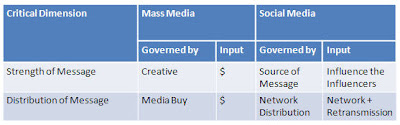
Social media is VERY different, each message you send has two aspects you need to care about; the message itself, and its effect on building or deteriorating your network. You cannot effectively buy your messaging infrastructure in social media, you must build it yourself, and this is a fundamental change in the way many of us think about getting a message to an audience.

So why invest NOW? The answer comes by looking at what it takes to influence an audience with a single message. Influencing an audience has two key aspects to it, getting the message to the audience (Distribution), and having them pay attention to it (Strength). In mass media, this is accomplished by acquiring a large distribution for your message using a media buy (television, radio, print), and developing an impactful message to deliver, through great creative, a compelling offer, and elegant copy. Success on both dimensions is roughly determined by how much you spend (many counter examples of expensive campaigns that flop miserably, notwithstanding).

Social media is very different. You are building a network, and it is not a network that you can acquire (note the controversy even in sponsored posts with Chris Brogan's now infamous (but well handled) controversy: http://www.chrisbrogan.com/advertising-and-trust/)

If you look at what drives our two key dimensions of influence in social media, strength of message and distribution, it could not be more different. Strength of message, as we all know from our own lives, is governed by the source of the message more than anything. I was looking for a new receiver a while ago, and I asked Chris Dias, a friend of mine, who happens to be a guy I trust on the topic of A/V equipment. He said "buy the Pioneer Elite, it's good". I bought it. Nothing to do with the creative of the message, everything to do with the source of the message.

Chris enjoys his status as the guru of A/V equipment in our social circle, and he maintains it by being knowledgeable, helpful, and usually right about the topic. Social media is no different.

Influencing influencers comes down to providing them with content of high enough quality that they find it useful to the groups they influence. Providing this high quality content, over time, in order to build credibility with the right influencers takes time, effort, integrity, and insightful content.
Then there's distribution. Social networks evolve over time, and as they evolve, they develop an ability to manage message retransmission through quality filters. Clay Shirky, one of my favourite writers on social media, puts it well in saying that it's not information overload, it's filter failure. (http://www.web2expo.com/webexny2008/public/schedule/detail/4817) If you think of Aunt Maud's (everyone has one) constant forwarding of those rehashed joke emails from the 90's you'll know what I mean about filters. The message may be received, but won't make it past the filter.

For a message to pass through a social network, it has to pass three milestones:
  • Received: the message comes from someone who is a connection

  • Filtered: the message passes the filter criteria; either actual system rules (TweetDeck), or engrained habits (reflexively deleting Aunt Maud's emails)

  • Retransmitted: the message is interesting enough ("remarkable" enough, as Seth Godin would say) to be passed on to colleagues and friends

The key thing though is that the paths in a social network are strengthened by traffic. A source providing quality content will be a source you view more credibly later. Being viewed as a quality source in the network for a single message will translate into being seen as a quality node in the network in general.

The way to grow a network in size and strength is to steadily and reliably contribute high quality, remarkable content to it.

Investing in social media is not the same as investing in TV advertising. It cannot be measure in the same way as the return on investment in a single message as an ad campaign can because of the fact that the network cannot be acquired, it can only be grown. Each message that passes through the network will be judged on its own merits and will increase or decrease the quality of your overall network and your ability to influence the influencers. The organic nature of this growth means that time is a critical factor, and one that cannot be expedited.

Unless you have fundamental doubts that social networks are likely to be one of the most critical information sources for prospective buyers in the coming years, there's every reason to begin your investment in social media sooner rather than later, to allow sufficient time for your network to grow and mature.
Read More...
Related Posts with Thumbnails
GiF Pictures, Images and Photos