Showing posts with label mass media. Show all posts

The Next Transition in Communication

Over time, the way in which communication happens has gone through some very interesting transitions. Each of them resulted in profound changes in information flow, and with that, significant changes in the discipline of marketing. We’re about to see the evolution of a fifth form of communication, and it will have an equally interesting effect on our lives.

1. One-to-One

The oldest form of communication is the one-to-one model. Face to face interactions and conversations were the main way in which messages were communicated. While very interactive, this was not a very scalable model at all. However, because it was the only way of conveying messages, it found an audience that was not overwhelmed with communication, and was likely much more receptive to new information.

2. Broadcast

The modern marketing industry was born with the advent of mass broadcast communications. Radio, print, or television enabled messages to be mass communicated to broad audiences. This was a highly scalable, but entirely non-interactive, as it was a one-way communication and allowed no way for the listener to engage with the communicator. Also, as broadcast grew, it reduced the attention span of audiences by overwhelming them with too many communications.

3. Email

The next interesting evolution in communication was with the advent of email. I’m not talking about email marketing, however, as that is much more similar to a broadcast model. Interpersonal email, however, added a very interesting element with the “Reply All” function. Now, the audience members in a communication group could easily respond to a discussion, and do so in a way that created ad hoc, topical group discussions. However, these discussions were closed to outsiders. A person who was not in the discussion would not see the discussion happening and could not join the discussion without explicitly being included by an insider.

4. Social Media

Solving this discovery problem, of course, was social media. Now, with the discussions happening in an open format, anyone can detect, read, or join existing discussions. The speed with which these communications happen has been well documented, and discussions on a particular topic can quickly grow to involve and influence hundreds of thousands of people. However, social media creates huge volumes of communications, most of which are not of interest. Filtering through this noise is a daunting challenge, and whereas most social media can be filtered by keywords or brand names, this still tends to result in an overwhelming volume of content.

5. Conversation Discovery

So what's next? As the major search engines apply their computing and analysis horsepower to understanding who is talking to whom about what, we may be on the verge of a fifth major shift in how information is communicated. Passive conversation discovery, guided by the algorithms of Google and Bing and their analysis of vast amounts of social media data, may be the way we discover what conversations are happening that may be of interest. Much like Amazon’s book recommendation systems which looks at “people like us” and sees what they are interested in, Google and Bing may soon be able to accurately detect and show specific conversations that are most likely to be of interest to each person. This finally allows the interactivity and openness of social media while not having the overwhelming volume of unfiltered social


Each of these evolutions in communication has changed how we interact with each other, how we learn, and how we market. This coming fifth transition promises to be as disruptive as any before it.

What are you doing to be ready?


(this article first appeared as a guest post on SavvyB2B) Read More...

You can't build your own television network

I was in a long conversation the other day trying to explain the importance of social media in the world of marketing, as I suspect many of us have tried. Given that I'm originally a techy and an engineer, I tend to approach things in a certain way, so my explanation went down that path also.


Regardless of whether messages are consumed via push or pull, word of mouth or television, social media or mass marketing, there's a fairly simple structure. You, as a marketer, want to get a message out, you have a "messaging infrastructure" to communicate that message, and you have an audience who you would like to receive (or discover) and digest your message.
Social media, and its broad set of tools and platforms is a way in which your message gets out to your audience. Mostly this is through through them discovering the message, rather than receiving it directly from you, as it is passed on through various nodes in the social networks that each recipient is a part of.

There have been a lot of posts about the growth rates in social media, and the way in which people consume their information. You get that. At some point in the future, "investing in social media" will have to be a key part of everyone's marketing plans. Right now it's not; some are investing in it, some are not. So the question is, why invest in it NOW, rather than wait to see how it evolves and what investments make sense. The current arguments on the proven ROI of social media are, to be frank, a bit anecdotal.
However, I think that the analysis is thinking of things a bit incorrectly. In the world of mass media, you are essentially renting the messaging infrastructure from an established provider such as a TV station or mailing house. You pay a certain amount and your message gets delivered. You measure the return of this investment on a single message basis - what effect did one advertising campaign have, for example.

Social media is VERY different, each message you send has two aspects you need to care about; the message itself, and its effect on building or deteriorating your network. You cannot effectively buy your messaging infrastructure in social media, you must build it yourself, and this is a fundamental change in the way many of us think about getting a message to an audience.

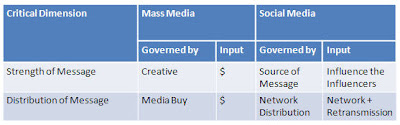
So why invest NOW? The answer comes by looking at what it takes to influence an audience with a single message. Influencing an audience has two key aspects to it, getting the message to the audience (Distribution), and having them pay attention to it (Strength). In mass media, this is accomplished by acquiring a large distribution for your message using a media buy (television, radio, print), and developing an impactful message to deliver, through great creative, a compelling offer, and elegant copy. Success on both dimensions is roughly determined by how much you spend (many counter examples of expensive campaigns that flop miserably, notwithstanding).

Social media is very different. You are building a network, and it is not a network that you can acquire (note the controversy even in sponsored posts with Chris Brogan's now infamous (but well handled) controversy: http://www.chrisbrogan.com/advertising-and-trust/)

If you look at what drives our two key dimensions of influence in social media, strength of message and distribution, it could not be more different. Strength of message, as we all know from our own lives, is governed by the source of the message more than anything. I was looking for a new receiver a while ago, and I asked Chris Dias, a friend of mine, who happens to be a guy I trust on the topic of A/V equipment. He said "buy the Pioneer Elite, it's good". I bought it. Nothing to do with the creative of the message, everything to do with the source of the message.

Chris enjoys his status as the guru of A/V equipment in our social circle, and he maintains it by being knowledgeable, helpful, and usually right about the topic. Social media is no different.

Influencing influencers comes down to providing them with content of high enough quality that they find it useful to the groups they influence. Providing this high quality content, over time, in order to build credibility with the right influencers takes time, effort, integrity, and insightful content.
Then there's distribution. Social networks evolve over time, and as they evolve, they develop an ability to manage message retransmission through quality filters. Clay Shirky, one of my favourite writers on social media, puts it well in saying that it's not information overload, it's filter failure. (http://www.web2expo.com/webexny2008/public/schedule/detail/4817) If you think of Aunt Maud's (everyone has one) constant forwarding of those rehashed joke emails from the 90's you'll know what I mean about filters. The message may be received, but won't make it past the filter.

For a message to pass through a social network, it has to pass three milestones:
  • Received: the message comes from someone who is a connection

  • Filtered: the message passes the filter criteria; either actual system rules (TweetDeck), or engrained habits (reflexively deleting Aunt Maud's emails)

  • Retransmitted: the message is interesting enough ("remarkable" enough, as Seth Godin would say) to be passed on to colleagues and friends

The key thing though is that the paths in a social network are strengthened by traffic. A source providing quality content will be a source you view more credibly later. Being viewed as a quality source in the network for a single message will translate into being seen as a quality node in the network in general.

The way to grow a network in size and strength is to steadily and reliably contribute high quality, remarkable content to it.

Investing in social media is not the same as investing in TV advertising. It cannot be measure in the same way as the return on investment in a single message as an ad campaign can because of the fact that the network cannot be acquired, it can only be grown. Each message that passes through the network will be judged on its own merits and will increase or decrease the quality of your overall network and your ability to influence the influencers. The organic nature of this growth means that time is a critical factor, and one that cannot be expedited.

Unless you have fundamental doubts that social networks are likely to be one of the most critical information sources for prospective buyers in the coming years, there's every reason to begin your investment in social media sooner rather than later, to allow sufficient time for your network to grow and mature.
Read More...
Related Posts with Thumbnails
GiF Pictures, Images and Photos